FIRST AGE – DECODE Season Kickoff Party this Saturday!

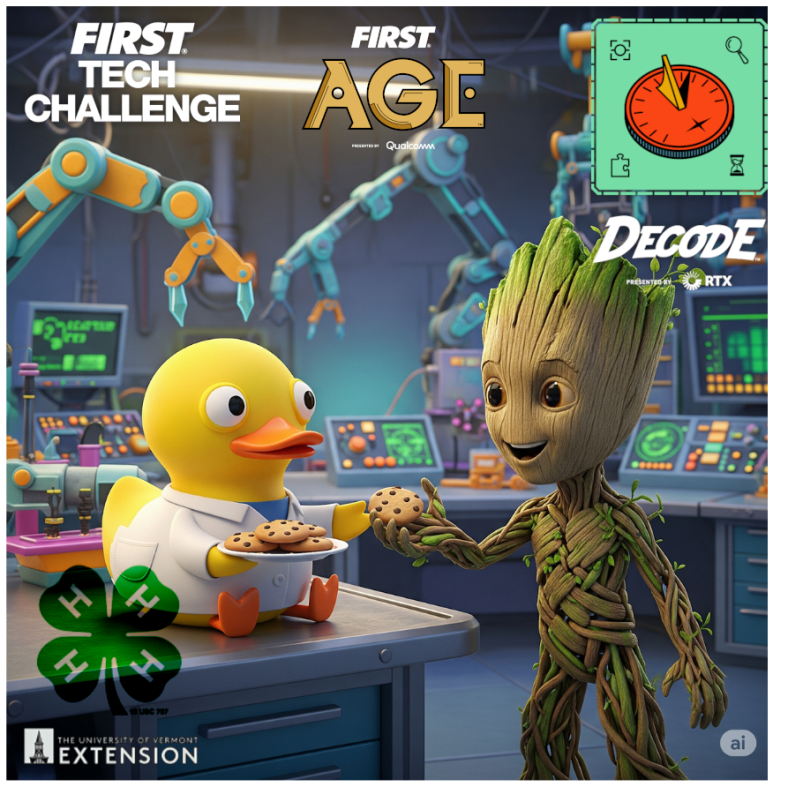
Manchester Machine Makers and the Cookie Clickers, sharing cookies in a robotics lab. FIRST Tech Challenge AGE - DECODE, in partnership with the Vermont Cooperative Extension.

The Cookie Clickers #18650 and the Manchester Machine Makers #16221 are hosting a party at the Manchester Community Library to celebrate the FIRST Tech Challenge AGE – DECODE kickoff on Saturday, September 6, 2025, 11am – 1:30pm.  We hope that you all will join us for this second annual Southern Vermont kickoff!

We will begin at 11am in the community room at the Manchester Community Library:

138 Cemetery Ave., PO Box 1105
Manchester Center, VT 05255
Phone: 802-362-2607

Map: https://duckduckgo.com/?t=ffab&q=138+Cemetery+Ave.%2C+PO+Box+1105+Manchester+Center%2C+VT+05255+Phone%3A+802-362-2607&iaxm=maps&source=maps

As teams arrive, we will form a panel of team representatives to discuss last year’s experiences and this year’s goals.

At noon, the challenge will be released by FIRST, and we will watch the livestream on the big screen to learn the rules of the new game. (If you can’t make it and want to sign up for a reminder to watch the livestream on your own, you can do that here).

Then, we open up the brand new field (thank you, FIRSTinVT!) so that everyone can experience the genius of the AGE: DECODE game, with whatever robots we have from last year, or from the summer’s experiments.  Feel free to bring your own robots as well!

There will be pizza for lunch, and each team will go home with a printed manual and a few game pieces.

We hope that you’ll all come and bring your expertise, ideas, and gracious professionalism to share!

Please let us know that you’re coming as a team so that we have enough manuals and game pieces on hand for you!

RSVP: ftc16221@gmail.com

Put it on your calendar:

What: FIRST Tech Challenge AGE: DECODE Season Kickoff

When: Saturday, Sept. 6, 2025 11am – 1:30pm

Where: Manchester Community Library (https://duckduckgo.com/?t=ffab&q=138+Cemetery+Ave.%2C+PO+Box+1105+Manchester+Center%2C+VT+05255+Phone%3A+802-362-2607&iaxm=maps&source=maps)

An Undersea Exploration at the New England Premier Event!

The team spent two days at the beginning of April competing in the first FIRST Tech Challenge New England Premier event at the Eastern States Exposition (“The Big E”) in Springfield, MA.

This event, similar in many ways to last year’s New England Regional event, was twice the size and fantastic to behold. While our team was specifically invited to this event, other teams earned their spot in their choice of Premier Events. Thus, we had teams coming from Alaska, Colorado, Florida, North Dakota, Oklahoma, Arizona, Delaware, Canada, and Khazakstan in addition to every state in New England.

Teams set up booths with information about their season and their robotics journeys, as well as giveaways. Ben did his best to collect something from every team, covering his t-shirt with pins and stickers. Some of the teams set up games in which to win a memento – Ben, Dhruv, and other team members did their parts and valiantly obtained even the most challenging prizes.

Meanwhile, our drivers relied on Monster beverages to keep up their strength; but on day two decided to stick to coffee. Too much caffeine produces a loss of delicate control of the gamepads, and makes it difficult to steady nerves!

Cordelia performed incredibly well. This season we avoided both bevel gears and chain drives, and the simplicity of the gearing made her chassis very reliable. We did, however, see some trouble with the claw servo, and had some ESD issues that interfered with the autonomous routine. The optical odometry sensor became less reliable as the competition went on, and next season we’re planning to try standard odometry pods to see if they’ll give us the precision we want with the reliability we need.

This was also the first multi-day competition we’d had. With the grueling match schedule, it wasn’t surprising to see that we were not the only team that had increasing wear-related issues as the matches wore on! Even the top teams had break-downs and emergency fixes – they just had fewer, and were more adept at getting them quickly fixed.

Even with the vexing breakdowns, all our team members kept up each others’ spirits and encouraged other teams as well! Miles made time to help the Khazak team with their autonomous routine, and the whole team volunteered to assist at every opportunity to lend parts, run errands, or just bring cheer.

Our fellow Vermont teams performed admirably. While every team had challenges, Vermont teams showed up full of Gracious Professionalism and worked to be their best.

DIVE: INTO THE DEEP at the Manchester Community Library

Join us at the library on September 7th between 11:30am and 2:30pm to kick off the next FIRST® Tech Challenge ocean-themed competition season: DIVE: INTO THE DEEP!

Image created by us from several images which were created using DALL-E by OpenAI, based on user prompts.

Manchester Machine Makers (MMM), a 4-H sponsored FIRST Tech Challenge team, is hosting the annual kickoff of the 2024-2025 competition season for Southern Vermont at Manchester Community Library.  At noon, we will watch the FIRST® live-streamed announcement and game animation. With a couple of basic robots, we can drive around the full game field provided by FIRSTinVT and will share printed copies of the new game’s Competition Manual. After the announcement, there will be time to brainstorm!

R.S.V.P. here, or to ftc16221@gmail.com so that we know how much pizza to bring. Donations to cover food and drink are graciously accepted, as are donations to help us fund our robots.

As a 4-H club, MMM is open to all students grades 7-12 (ages 12-18) in the local area who are interested in Science, Technology, Engineering, Art, and Math  (STEAM) and/or robotics.  MMM invites anybody interested in STEAM to join us for the kick off and learn more about what is being done to promote STEAM education in the community.

During the 2024-2025 FIRST® season, FIRST® DIVE presented by Qualcomm, teams will use their STEM and collaboration skills to explore life beneath the surface of the ocean.

Along the way, we’ll uncover the potential in each of us to strengthen our community and innovate for a better world with healthy oceans. Join us as we explore the future.

To learn more about the FIRST® Tech Challenge, please visit: https://www.firstinspires.org/robotics/ftc

Competition Day!

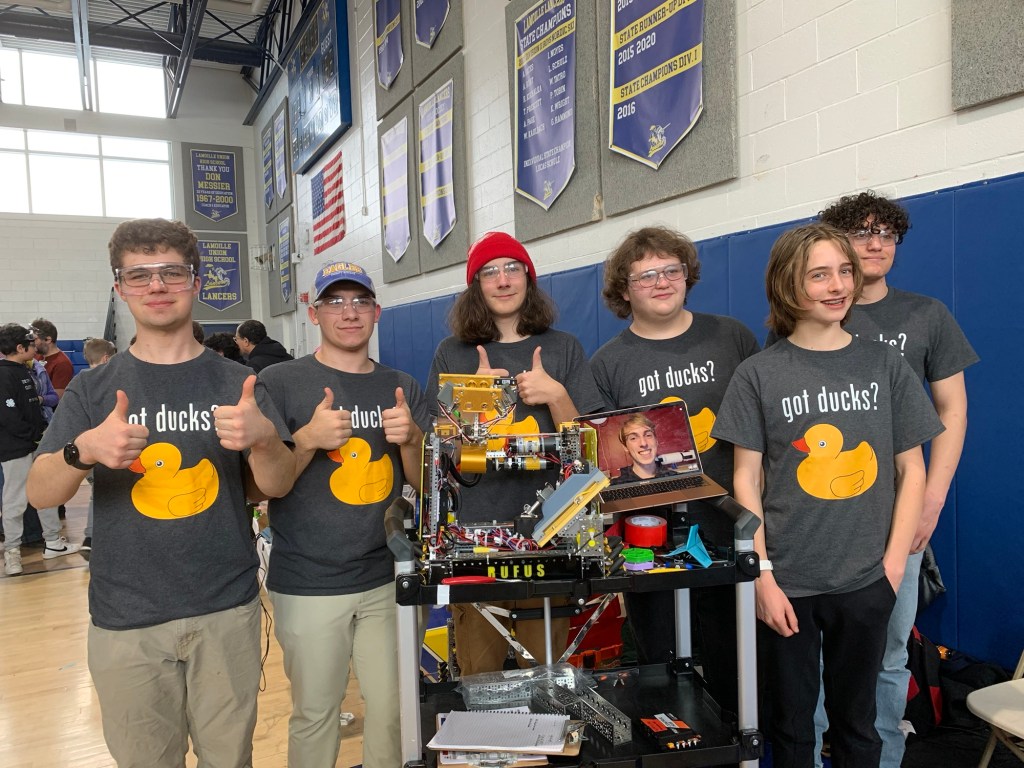
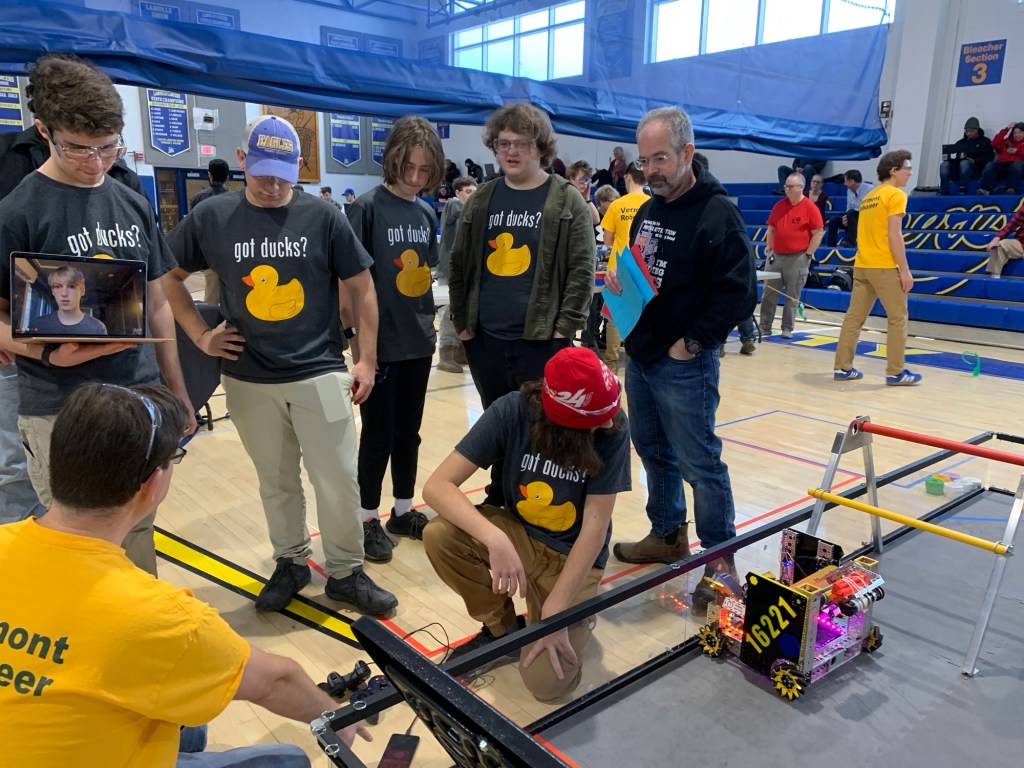
Manchester Machine Makers at Lamoille Union High School

Today was the day! We all travelled north to attend the Vermont State Championship FIRST Tech Challenge competition, where the team had a successful and eventful day.

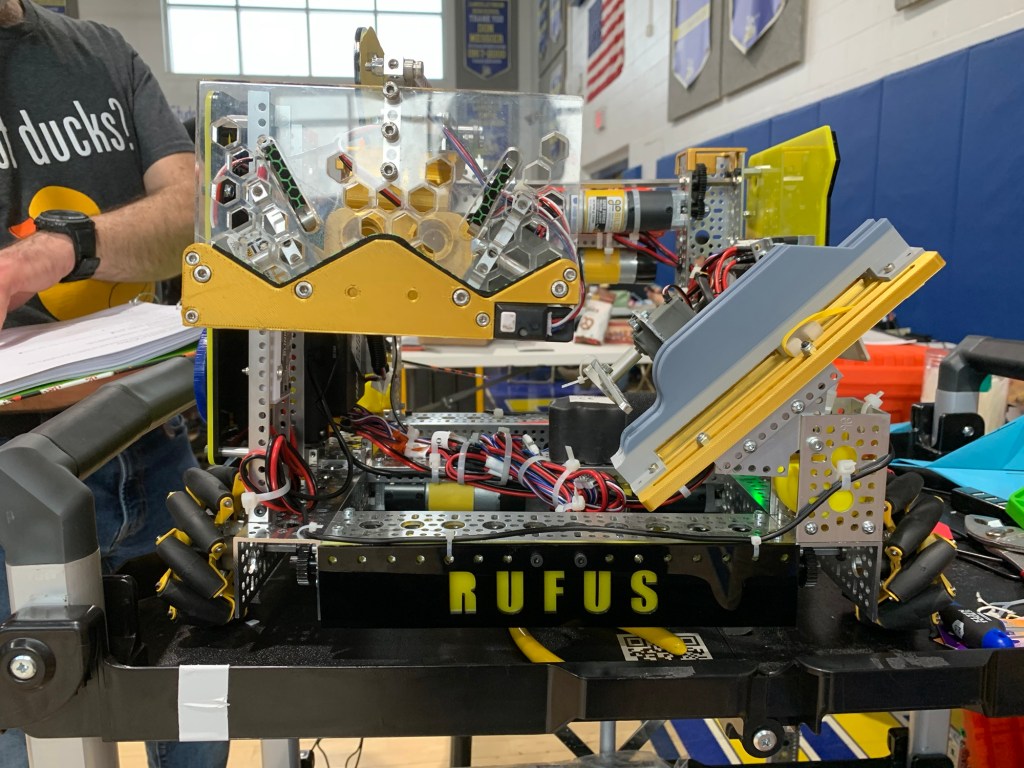
It was a rough start- Rufus, our robot, suddenly began having connection issues, switch problems, and more! We had to return at the last minute to finally pass the field inspection, but even after we thought it was working, the next thing we knew it had stopped again. With the help of the Mansfield Mechanics United, our first alliance partner, we learned that the way we had connected our hubs together wasn’t the best way, and they loaned us a cable to get working.

The first match was rough, with the hurried debugging process having reversed cables and left some hardware uninitialized. But in the few moments before the next match the team dove in and got it fixed up, and from there our ranking steadily improved.

The judges gave the team an excellent evaluation on their presentation, and came around during the day between matches to talk further about the robot and the design and build process.

We followed up with successful match partnerships with Insufficient Power, the Cookie Clickers, the Wired Cats, and a CVU team. After the last qualifiers were done, we were in fourth place!

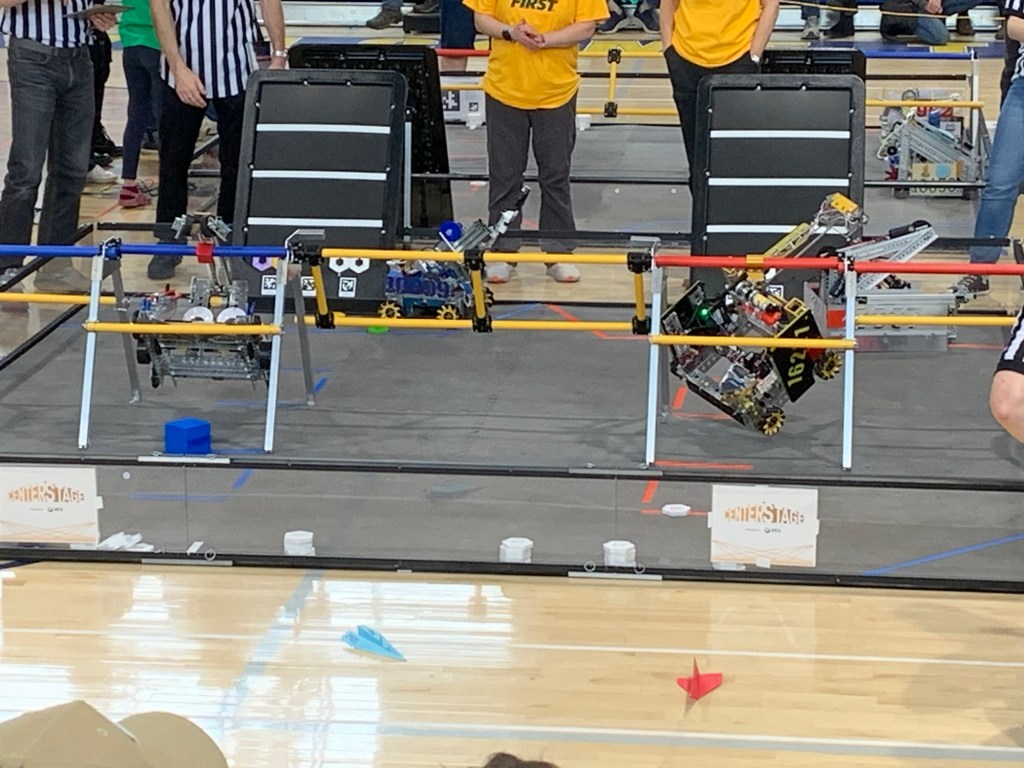
After a variety of negotiations, we agreed to pair with the Wired Cats again for the semifinal round, where we won two of three matches to proceed to the finals. Although we were knocked out of the final round, the Drive team did a fantastic job with Rufus. Despite irregular steering, our alliance built two mosaics in each of our last two games and worked together nicely.

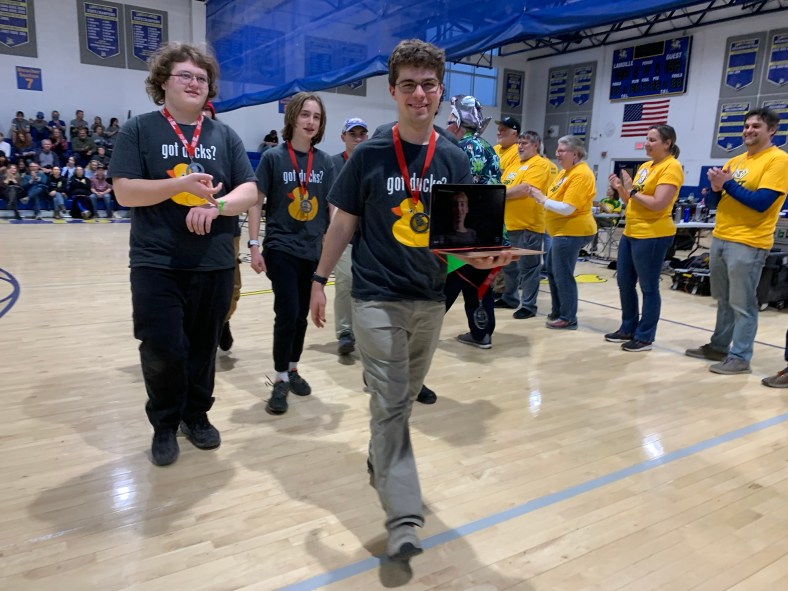
In the end, the team brought home medals as the second place alliance partner, and was honored with the Design Award, and first runner up for the Control Award – and we will advance to the regional tournament in Massachusetts in April!

We have several improvements to make in hardware and software, and Rufus is going to be amazing – but a huge congratulations to the team for their incredible accomplishments today and throughout the season!

Work In Progress: October

So it’s been a while since we’ve posted, but that doesn’t mean we’ve been sitting on our duffs! No indeed, our workshop has been filling up with assorted springy poles, rulebooks, and robot parts, along with kids to put them together.

This season, the challenge involves “creating circuits” by placing cones over the aforementioned springy poles. If your cone is the one on top, you’ve claimed the “junction” and can count it as a connection point. Translating that to requirements was the first task. We spent the first couple of meetings throwing ideas around.

Because there are many ways to approach the basic problem of lifting and placing cones, the team decided to try more than one prototype. Zach set about designing an arm, which is a new assembly that the team hasn’t tackled before; while Isaac designed an improved slide/pulley lift based on the lessons that we learned last year.

We have shifted our coding practice over to Blocks, so that the entire team can work on the programs. Aleks has explored the “ExportToBlocks” functionality in the FTC codebase, changing over our instance-based classes for our assemblies into static, global members so that it can be used from Blocks OpModes.

We are always open to new members – there is plenty left to accomplish! So if you’re interested in joining our team, drop us a line or talk to Isaac, Takoda, Aleks, or Zach at school.

Programming our Navigation Bot

We built it, now we need to make it go, right?

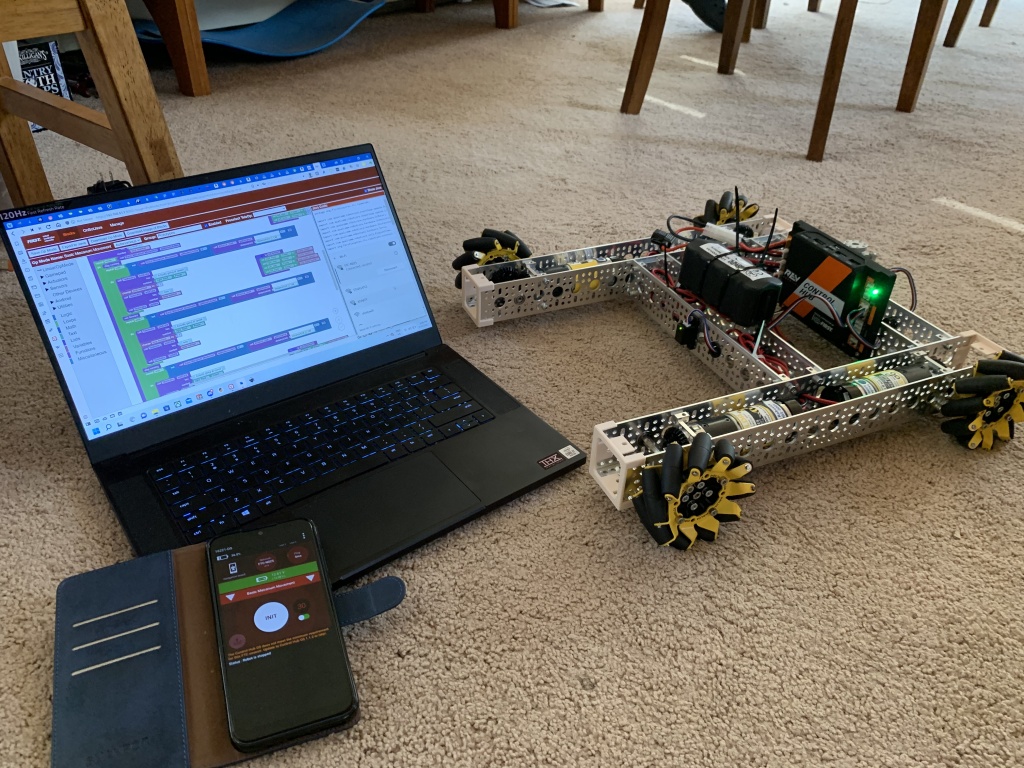
The driver's station, a laptop with Blocks, and the navigation robot.
The navbot, and how we programmed it.

Our Navigation platform (how about “navbot” for now, at least until we name it properly – eh, Team?) consists of the goBilda mecanum “strafer chassis” with two REV distance sensors. We will add another two distance sensors before we are done, and a USB camera on a swivel mount, but that’s an upcoming project yet.

So we have a chassis and a couple of sensors to work with. No big deal! We pull up Blocks for this, and get it moving… why isn’t it moving?

So despite the fact that we are programming in blocks, guess what? We actually still need to know what we are doing. The motors still need to be properly initialized before they will run. Turns out that blocks can actually teach you real programming- who knew? We set the motors’ run mode and direction, making an initialization routine.

You have to tell the motors what to do before they will do anything!

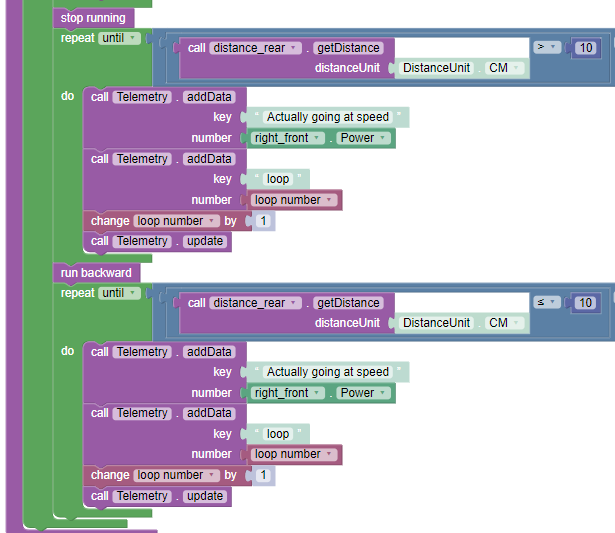
We put the chassis up on a book before trying to actually run it on a surface. Lifting the wheels off the ground allows them to run without spinning the navbot in circles – because the way the chassis is hooked up, the right-hand motors spin backwards from the left-hand motors. With that fixed in our code, we made a routine to run forwards, a routine to run backwards, and a routine to stop. Something like this (only in blocks, which are prettier):

private void run_forward() {
    right_front.setPower(motor_speed);
    right_rear.setPower(motor_speed);
    left_rear.setPower(neg_motor_speed);
    left_front.setPower(neg_motor_speed);
  }

There are two ways in which we could have fixed the wheel direction. One way was to set the direction on the left hand motors to REVERSE; the other way is to set the power to negative values. We chose the latter method.

The next step was to involve the distance sensors. We decided to have it run until it came close to an object, then stop. So, in pseudocode:

run_forward()
do
   just_output_telemetry()
until (sensor.distance <= 30cm)
stop_running()

We had fun almost running into the dog (and he got very nervous) a few times, then added in the other direction. Since the front sensor is in the middle of the robot and the rear sensor is at the rear edge, the distance was adjusted to suit:

run_backward()
do
   just_output_telemetry()
until (sensor.distance <= 10cm)
stop_running()

You’ll notice that we actually wait to make sure that we’re not already less than 10cm from something before we run backwards. We do the same check before running forwards. So the full loop is:

wait until front.distance > 30cm;
run_forward; 
wait until front.distance <= 30cm;
stop_running;
wait until back.distance > 10cm;
run_backward;
wait until back.distance <= 10cm;
stop_running;

So it’s not very smart yet, but now it goes back and forth like a pendulum-on-wheels.

Just don’t run into the dog…!

Up next: the camera! Stay tuned.

Congratulations to our Graduates!

It’s been a great year, and we’ve been truly lucky to have such a great team. So it’s with an equal measure of dismay and pride that we send off our three Seniors into their next adventures: Charlotte, founding member, hardware specialist, public relations lead, and project manager (and by night, more of the same!); Jacob, engineer and driver extraordinaire, and Amos, all-around assembly designer/builder/musician/etc. We wish you all great success and we will miss you!

While we will have a hard time filling all those shoes, we will have our returning members with yet another season’s worth of experience under their belts. And of course, we’ll have plenty of room for more budding roboticists! David and Patty are returning as coaches with at least some of Meg’s help (what would we do without Meg?); and we are partnering with EPS, and with BBA, to make robotics engineering more available to the youth in our community.

This summer’s project is to construct both a stationary programming board and a mobile programming board as a development platform for our navigational systems, funded by a grant from the Vermont Academy of Science and Engineering this past winter. We don’t know what the next game will be, but it’s a fair guess that we’ll have to navigate! We will use a goBilda strafer chassis as a base, with the REV Robotics Control Hub, a camera, and four distance sensors. Stay tuned for updates.

We’re looking forward to the start of next season’s game, “Power Play”, and we hope you’ll join us!

(Also, we have the contact info for Charlotte, Jacob, and Amos in our back pockets. Just sayin’.)

a photobombing rubber ducky

Freya’s Screen Debut, and a New Home

We’ve been taking an actual Spring Break, believe it or not. Members slept in, went places, and did things completely unrelated to robots. No, really!

Oh, ok, so we did start working on a new project. Over a weekend we got together to storyboard and film Freya for her screen debut: Freya and Ducks à l’Orange! No duckies were harmed in the making of this film. We promise.

We brought Freya to meet her adoring public at the Bennington Area Makerspace on May 7th, joining the Cookie Clickers at their Open House. She worked beautifully!

We also started May in our new home in the Smith Center at Burr and Burton Academy. We are incredibly excited to be invited to share the Robotics Lab with Mr. Morrison’s students! We had visitors there last Monday, and all had a great time driving around the lab and delivering balls, cubes, and ducks to each other.

Delivering Freight in the Smith Center!

It’s been a great year in our workshop provided by TPW Real Estate, and we will miss our awesome garage space. It allowed us to meet safely this year even during the Delta and Omicron waves, so that we could bring Freya to the VT State Championship.

Having community support is how we keep the program going, bringing STEAM enrichment to area students. While the majority of our current members are attending BBA, we welcome 7th-12th graders from any school (or homeschool) in the area. There are no membership dues or costs beyond transportation; expenses come entirely from grants and donations. Thus we are truly grateful for the support of TPW and BBA in providing the team a home.

2021-2022 Post-Competition Update

Early morning arrival at the Vermont State FTC Championship, March 19, 2022.  Left to right: Zach, Jacob, Isaac, Charlotte, Takoda.  Photo credit: Coach Meg.
Early morning arrival at the Vermont State FTC Championship, March 19, 2022. Left to right: Zach, Jacob, Isaac, Charlotte, Takoda. Photo credit: Coach Meg.

On Saturday, March 19, 2022, we took our robot, Freya, to the Vermont State FIRST Tech Challenge Championship competition hosted by the CVU RoboHawks in Hinesburg, VT. The competition involves several rounds of Qualification Matches, followed by the Semi-Final Matches, followed by the Final Match based on the rankings earned during the previous matches.

The team started out the day with an interview with two judges. We presented the season’s work, represented in our Engineering Portfolio and our larger Engineering Notebook. These had been polished up over the course of the previous week.

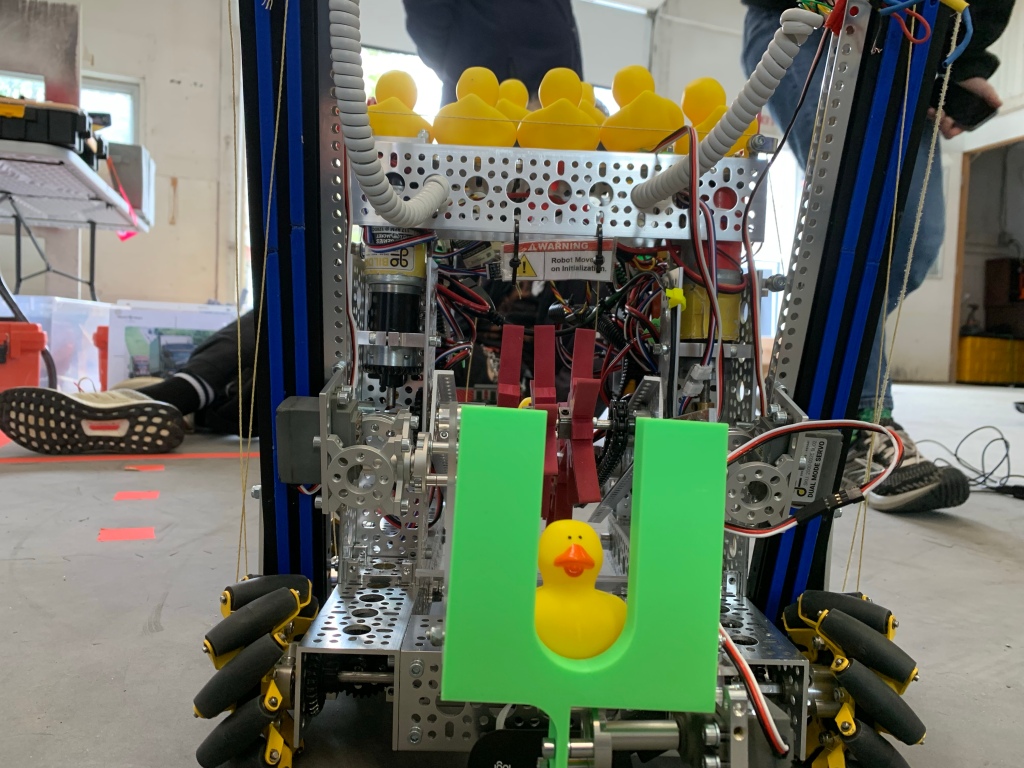
Freya was called up for the first match of the day, bright and early, partnered with the Ringers on the Blue Alliance. After a serious fumble in the Autonomous period, she was able to recover well enough to deliver ducks in the Endgame and score points for the Alliance. However, her delivery system was broken beyond on-site repair, and the remainder of the matches were played without it.

Our next Alliance was with the Cookie Clickers, our friends from the Bennington Area Makers. Both robots gave a creditable performance. We went on to play in a total of 6 matches, with each match improving as the drivers became adept at running Freya without her delivery slides and chute. They were able to use her intake to push freight all the way through, delivering to the bottom level of each hub.

The team was interviewed in the pit by the judges, who stopped by with each team to discuss their robots and their approach to the problems posed by the game challenges.

While Freya did not advance past the qualifying matches, she impressed the judges with her design and her modularity. She was able to compete without all her assemblies, and she was able to swap out her alliance markers between red and blue with a little Velcro™. The judges were also impressed by the team’s resilience and their engineering process through the season.

Congratulations to our Team on a Season and Game that was well thought, well designed, and well-played!

Judged Awards

The team came home with three awards – Second Place for the Think Award, Second Place for the Control Award, and First Place for the Design Award.

The Think Award: Removing engineering obstacles through creative thinking.

This judged award is given to the Team that best reflects the journey the team took as they experienced the engineering design process during the build season. The engineering content within the portfolio is the key reference for judges to help identify the most deserving Team. The Team’s engineering content must focus on the design and build stage of the Team’s Robot.

The Team must be able to share or provide additional detailed information that is helpful for the judges. This would include descriptions of the underlying science and mathematics of the Robot design and game strategies, the designs, redesigns, successes, and opportunities for improvement. A Team is not a candidate for this award if their portfolio does not include engineering content.

The Manchester Machine Makers earned Second Place at the Vermont Championships for the Think Award. The team created an Engineering Notebook with detailed and elaborate descriptions of all the systems of the robot, including the design and engineering process of both hardware and software, and the support systems provided by fundraising and community partnerships. This is the third year running in which the Team has been recognized in the Think Award category.

Control Award sponsored by Arm, Inc.: Mastering robot intelligence.

The Control Award celebrates a Team that uses sensors and software to increase the Robot’s functionality in the field. This award is given to the Team that demonstrates innovative thinking to solve game challenges such as autonomous operation, improving mechanical systems with intelligent control, or using sensors to achieve better results. The control component should work consistently in the field. The Team’s engineering portfolio must contain a summary of the software, sensors, and mechanical control, but would not include copies of the code itself.

The Manchester Machine Makers earned Second Place at the Vermont Championships for the Control Award. The team was able to show its consideration for improving the driver controls, and effective use of sensors and algorithms in its software.

Design Award: Industrial design at its best.

This judged award recognizes design elements of the Robot that are both functional and aesthetic. The Design Award is presented to Teams that incorporate industrial design elements into their solution. These design elements could simplify the Robot’s appearance by giving it a clean look, be decorative in nature, or otherwise express the creativity of the Team. The Robot should be durable, efficiently designed, and effectively address the game challenge.

The Manchester Machine Makers earned First Place at the Vermont Championships for the Design Award! The team put a lot of thought into the design of Freya, considering all aspects of how she would need to be both used and maintained. The judges appreciated the swappable Alliance markers as well as how well the robot performed on the field after having removed one component. The modularity of the design and flexibility of the robot’s performance were a key factor in the team’s success.

Dean’s List

Our very own Isaac Vernon was recognized as a Finalist for the Dean’s List Award as well.

Congratulations!